Understanding Semiconductors and Their Essential Properties

Semiconductors are materials that have a conductivity level between conductors and insulators. They play a crucial role in electronics by enabling the functionality of various devices. You find semiconductors in smartphones, laptops, and medical equipment. Their importance cannot be overstated; they allow for high-performance computing and advancements in technologies like artificial intelligence.
Here are some key impacts of semiconductors:
They power connectivity technologies such as Wi-Fi and Bluetooth.
They enhance the accuracy of medical imaging devices.
They drive innovations in automotive and consumer electronics.
In fact, the global semiconductor market is projected to grow significantly, reaching approximately $1,477 billion by 2034. Understanding semiconductors helps you appreciate their role in everyday technology.
Key Takeaways
Semiconductors are crucial for modern electronics, enabling devices like smartphones and medical equipment.
Doping semiconductors with impurities enhances their conductivity, leading to n-type and p-type materials.
Temperature affects semiconductor performance; higher temperatures can increase conductivity.
The semiconductor market is projected to grow significantly, driven by advancements in AI and telecommunications.
Understanding semiconductor properties can lead to the development of faster, more energy-efficient devices.
Semiconductors Defined
Basic Functionality
Semiconductors are materials that have a unique ability to conduct electricity. Their conductivity lies between that of conductors, like copper, and insulators, like rubber. This property allows semiconductors to play a vital role in electronics.
You can see the conductivity of different materials in the table below:
Material Type | Resistivity (Ωcm) |
|---|---|
Conductors | 10^-8 to 10^-4 |
Semiconductors | 10^-4 to 10^8 |
Insulators | 10^8 to 10^18 |
The conductivity of semiconductors typically ranges from 10⁻⁴ to 10⁴ (Ω cm)⁻¹. For example, germanium has a conductivity of approximately 4.6×10⁻¹ (Ω cm)⁻¹. Doping silicon with pentavalent or trivalent atoms can further increase its conductivity.
Semiconductors are essential for modern electronics because they enable the creation of integrated circuits and microprocessors. They bridge the gap between conductors and insulators, providing a unique combination of controllability, efficiency, and versatility. Their ability to switch and amplify signals is crucial for the functionality of electronic devices.
Moreover, semiconductors allow the integration of millions of components onto tiny chips. This capability is vital for developing compact and powerful devices. You will find semiconductors in various applications, from smartphones to IoT devices, where they act as the 'brains' that process and store information.
Types of Semiconductors

Intrinsic vs. Extrinsic
Semiconductors can be classified into two main types: intrinsic and extrinsic. Intrinsic semiconductors are pure materials without any impurities. They have low electrical conductivity and their performance depends mainly on temperature. For example, pure silicon and germanium are intrinsic semiconductors.
On the other hand, extrinsic semiconductors are doped with impurities to enhance their electrical properties. This doping process creates two subcategories: n-type and p-type semiconductors. The table below summarizes the differences between intrinsic and extrinsic semiconductors:
Parameter | Intrinsic Semiconductor | Extrinsic Semiconductor |
|---|---|---|
Definition | Pure form without impurities. | Doped with impurities. |
Types | No classification. | Classified into P-type and N-type. |
Doping | No doping. | Doping is performed. |
Charge carrier density | Equal number of electrons and holes. | Unequal number of holes and electrons. |
Conductivity | Low electrical conductivity. | High electrical conductivity. |
Dependency of conductivity | Depends only on temperature. | Depends on temperature and impurity amount. |
Conductivity at 0 Kelvin | Does not conduct. | Can conduct. |
Cause of charge carrier production | Produced by thermal agitation. | Produced by thermal agitation and impurities. |
Operating temperature | Low operating temperature. | High operating temperature. |
Fermi level | Lies between conduction and valence band. | Depends on type (N-type or P-type). |
Ratio of charge carriers | Ratio is 1. | Ratio is not unity. |
Examples | Pure silicon and germanium. | Doped silicon and germanium with impurities like As, P, etc. |
N-Type and P-Type
Doping alters the electrical characteristics of semiconductors, leading to n-type and p-type materials. N-type semiconductors form when you add donor impurities, such as phosphorus or arsenic, which have five valence electrons. This process introduces extra electrons, enhancing electrical conductivity. In n-type materials, the majority carriers are negatively charged electrons.
Conversely, p-type semiconductors result from introducing acceptor impurities like boron or aluminum, which have three valence electrons. This creates holes that act as positive charge carriers. In p-type materials, the majority carriers are positively charged holes. Understanding these types of semiconductors is crucial for grasping how electronic devices function.
Properties of Semiconductors
Conductivity and Resistivity
Semiconductors have unique conductivity properties that set them apart from metals and insulators. Their conductivity lies between these two extremes, making them versatile for various applications. Here’s how they compare:
Metals exhibit very high conductivity. Free electrons move easily within the metal lattice, allowing for efficient current flow.
Semiconductors have intermediate conductivity. You can control their conductivity by changing temperature or adding impurities through a process called doping.
Insulators show very low conductivity. Their electrons are tightly bound, which prevents current flow.
In terms of band gaps, the differences are also significant:
Conductors have negligible band gaps, allowing for high conductivity.
Semiconductors possess moderate band gaps, enabling some conductivity under specific conditions.
Insulators have large band gaps that inhibit significant conduction, resulting in low conductivity.
This controllable conductivity makes semiconductors essential in electronic devices. You can find them in everything from smartphones to computers, where they help manage electrical signals efficiently.
Temperature Effects
Temperature plays a crucial role in the behavior of semiconductors. One key aspect is the negative temperature coefficient of resistance. This means that as the temperature increases, the resistance of semiconductors decreases. Here’s how it works:
In semiconductors, thermal energy promotes electrons to the conduction band. This process enhances conductivity, allowing more current to flow.
In contrast, metals typically exhibit a positive temperature coefficient of resistance. Their resistance increases as the temperature rises due to increased vibrations of the metal lattice, which impedes electron flow.
Understanding these temperature effects is vital for designing reliable semiconductor devices. For instance, advancements in thermal interface materials and heat dissipation techniques help maintain operational stability. These innovations ensure that semiconductor devices perform reliably, even when exposed to temperature variations in real-world applications.
By grasping these properties, you can appreciate how semiconductors function in various technologies. Their ability to adapt to temperature changes and their unique conductivity characteristics make them indispensable in modern electronics.
Applications of Semiconductors
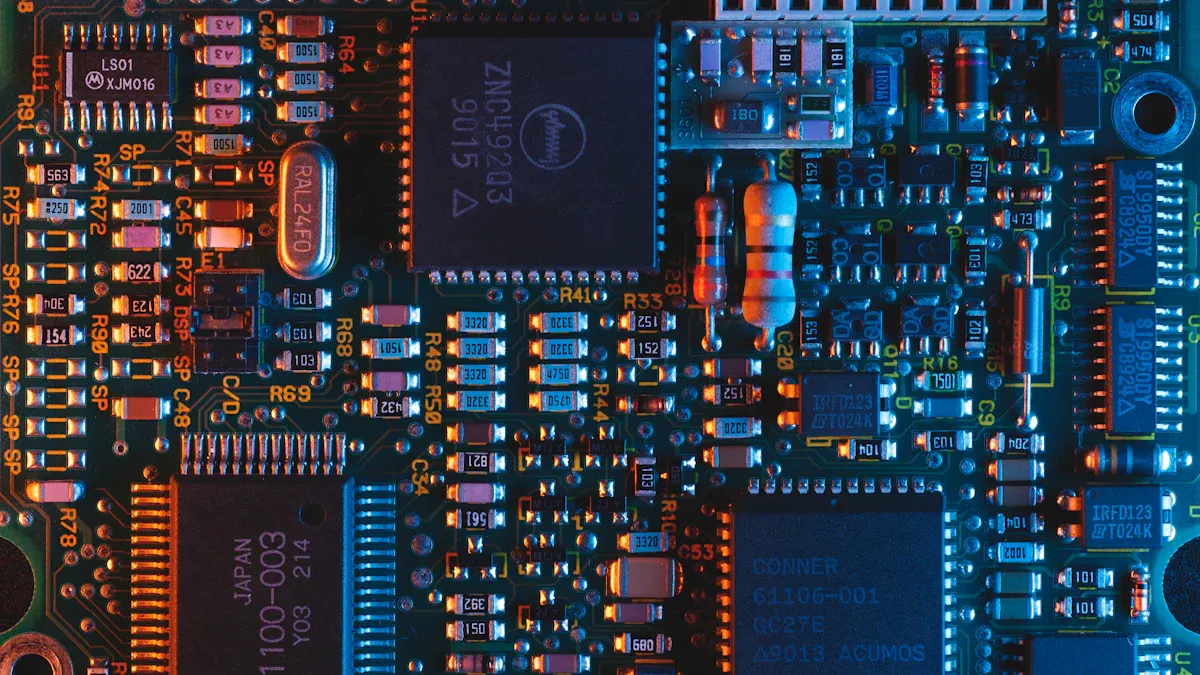
Consumer Electronics
Semiconductors are the backbone of modern consumer electronics. You encounter them in various devices that enhance your daily life. Here are some common uses:
Transistors: These tiny switches control electrical signals in devices.
Diodes: They allow current to flow in one direction, protecting circuits.
Integrated Circuits: These compact chips combine multiple functions, making devices smaller and more efficient.
Processing Chips: They power everything from smartphones to laptops, enabling complex tasks.
Recent innovations in semiconductor technology, such as nanotechnology and 2-nanometer technology, improve efficiency and performance. These advancements ensure your devices remain powerful and energy-efficient.
Telecommunications and Automotive
Semiconductors play a crucial role in telecommunications and the automotive industry. They enable high-speed data transmission, which is essential for modern communication systems. Here are some key contributions:
Semiconductors enhance photonics, boosting data transmission speeds.
They support high-frequency transmissions, vital for 5G networks.
They contribute to ultra-low latency and increased bandwidth, improving connectivity.
The networking and communication segment is projected to dominate the semiconductor market, capturing a 30.4% share by 2025. The surge in data traffic from internet growth and smartphone usage drives the demand for advanced semiconductor solutions.
In the automotive sector, semiconductors are transforming vehicles. They enable advanced features like driver assistance systems and vehicle-to-everything (V2X) communication. These technologies rely on real-time data from sensors and cameras, making vehicles safer and more efficient. As the automotive industry evolves with electric vehicles and autonomous driving, the demand for sophisticated semiconductor components continues to rise.
Semiconductors play a vital role in modern technology. They enable devices like diodes, transistors, and integrated circuits. Here are some key takeaways about their importance:
The semiconductor industry is set to become a trillion-dollar industry by 2030.
AI-driven computing will drive over 50% of market growth by 2029.
Sustainability challenges loom, with projected electricity consumption reaching 237 TWh globally by 2030.
Understanding semiconductor properties can lead to faster and more energy-efficient devices. Emerging materials like graphene and perovskites promise to drive future innovations. Appreciate how semiconductors shape your daily life and the technology of tomorrow!
FAQ
What are semiconductors used for?
Semiconductors power various electronic devices, including smartphones, computers, and medical equipment. They enable functionalities like signal amplification, switching, and data processing.
How do temperature changes affect semiconductors?
Temperature changes impact semiconductor conductivity. As temperature rises, resistance decreases, allowing more current to flow. This behavior is crucial for device performance.
What is doping in semiconductors?
Doping involves adding impurities to semiconductors to enhance their electrical properties. This process creates n-type and p-type semiconductors, which have different charge carriers.
Why are semiconductors important in electronics?
Semiconductors are vital because they enable the creation of integrated circuits and microprocessors. They allow for compact, efficient devices that power modern technology.
What is the future of semiconductors?
The semiconductor industry is evolving rapidly. Innovations in materials and technologies, such as AI and 5G, will drive growth and improve device performance in the coming years.
See Also
Exploring Integrated Circuits and Their Importance in Electronics
Why ON Semiconductor Power Management Is Crucial Today?
What Distinguishes ON Semiconductor Chips From Others?