The differences between MOSFETs and bipolar transistors
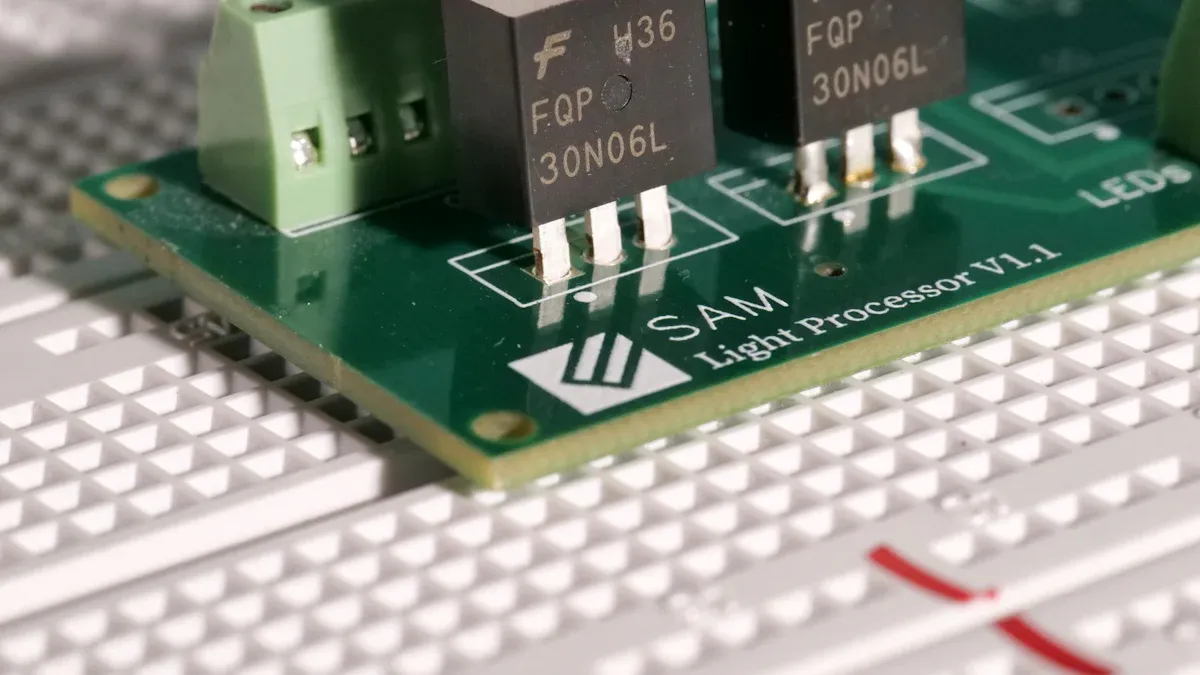
Understanding the differences between MOSFETs and bipolar transistors is important for people in electronics. Each type of transistor has an important job in different uses. For example, MOSFETs switch faster and lose less energy. This makes them great for high-speed tasks. On the other hand, BJTs are better for low-speed amplification. Picking the right type can greatly affect how well your projects work. You should think about these things to get the best results.
Definitions
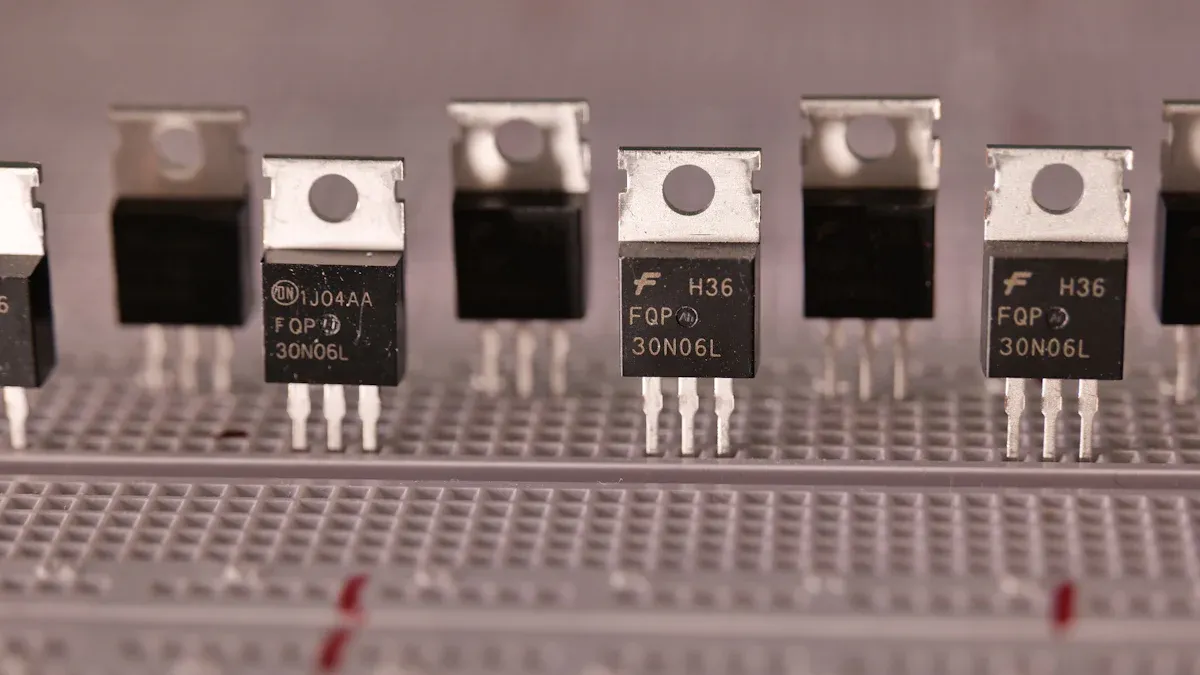
What is a MOSFET?
A MOSFET stands for Metal-Oxide-Semiconductor Field-Effect Transistor. It is a type of transistor used for switching and amplifying electronic signals. A MOSFET has three parts: the gate, the source, and the drain. The gate controls how much current flows between the source and drain. This control happens when you apply voltage to the gate. This makes MOSFETs devices that are controlled by voltage.
Here are some important features of MOSFETs:
Made for fast switching and amplification
Has a metal gate, oxide layer, and semiconductor
The oxide layer (usually silicon dioxide) provides insulation
Modern MOSFETs often use polycrystalline silicon for better performance
Source and drain areas are doped semiconductors that help charge movement
MOSFETs work well in situations where low power use is important. They have high input impedance, which helps keep signals clear in high-frequency uses. Their quick switching speed makes them great for battery-powered devices like smartphones.
What is a BJT?
A BJT stands for Bipolar Junction Transistor. It is another type of transistor used in electronic circuits. A BJT has three layers of semiconductor material, creating two PN junctions. The three parts are the emitter, base, and collector. The base is between the emitter and collector and is made from lightly doped, high-resistivity material.
Here are some key features of BJTs:
A BJT is a three-terminal semiconductor device with two PN junctions.
It has three differently doped semiconductor areas: emitter (p-type or n-type), base (n-type or p-type), and collector (p-type or n-type).
Small voltage changes at the base-emitter can cause big changes in current between the emitter and collector. This allows BJTs to amplify signals.
BJTs are current-controlled devices. This means a small current at the base can control a larger current from the emitter to the collector. They are often used in places where amplification is needed, like audio devices and low-speed switching.
Feature | MOSFETs | BJTs |
|---|---|---|
Control Type | Voltage-controlled | Current-controlled |
Input Impedance | High | Low |
Power Consumption | Low | Higher |
Switching Speed | Fast | Moderate |
Versatile (switches, amplifiers) | High-speed switching, amplification | |
Thermal Performance | Strong with proper management | Can overheat easily |
Knowing these definitions helps you understand the differences between MOSFETs and BJTs. Each type has special jobs in electronic circuits, making them good for different uses.
Working Principles
MOSFET Operation
A MOSFET works as a voltage-controlled device. You control it by putting voltage on the gate terminal. When you add a positive voltage to the gate of an N-channel MOSFET, it makes an electric field. This field pushes holes away in the substrate. This creates an inversion layer where free electrons gather. This process forms an n-type channel. It lets current flow from the drain to the source.
When you increase the gate voltage, the channel can carry more current. This means more current can pass through. If you lower the gate voltage, the channel carries less current. This lets the MOSFET act like an electronic switch. Here’s a quick overview of the key parts:
Pin | Function |
|---|---|
Gate | Controls the MOSFET by applying voltage to create an electric field. A positive gate voltage turns on an N-channel MOSFET. |
Drain | In an N-channel MOSFET, current flows out from the drain; it connects to the load in a circuit. The voltage difference affects current flow. |
Source | In an N-channel MOSFET, current flows into the source; it usually connects to ground. The source potential compared to the gate decides switching behavior. |
BJT Operation
A Bipolar Junction Transistor (BJT) works as a current-controlled device. You can control the collector current (IC) by changing the base current (IB). The link between these currents follows the equation IC = βIB, where β is the current gain. This means a small change in base current can cause a big change in collector current.
Here are some key points about BJTs:
The base terminal controls how the transistor works.
The emitter sends carriers into the base, allowing for amplification.
The collector gathers the carriers, leading to a larger output current.
Understanding these working principles helps you see the differences between MOSFETs and BJTs. Each type has special features that make them good for different uses in electronics.
Types of Transistors
MOSFET Variants
MOSFETs have different types, each made for special jobs. Here are the main types:
N-Channel MOSFETs: These let current flow when you put a positive voltage on the gate. They are often used for fast switching and amplifying signals.
P-Channel MOSFETs: These work with a negative voltage at the gate. They are good for switching loads in battery-powered devices.
Enhancement Mode MOSFETs: These need a voltage to create a path for current. They are the most common type in modern circuits.
Depletion Mode MOSFETs: These are usually on and stop working when you apply a voltage. They are used in safe designs and processing analog signals.
Here’s a table that shows the different types of MOSFETs:
Type | Description |
|---|---|
N-Channel Enhancement | Lets current flow when a positive voltage is on the gate. |
P-Channel Enhancement | Lets current flow when a negative voltage is on the gate. |
N-Channel Depletion | Conducts current when no voltage is applied, and stops with a positive voltage. |
P-Channel Depletion | Conducts current when no voltage is applied, and stops with a negative voltage. |
BJT Variants
Bipolar Junction Transistors (BJTs) also have two main types, each for different uses:
NPN Transistor: This type works with a positive voltage on the base. It lets electrons flow from the emitter to the collector. You often use NPN transistors for low-side switching and general amplification.
PNP Transistor: This type works with a negative voltage on the base. It allows current to flow in the opposite direction. PNP transistors are usually used for high-side switching and complementary amplifiers.
Both types of BJTs are important in many electronic uses. Knowing these differences helps you pick the right transistor for your projects.
Advantages and Disadvantages
MOSFET Benefits
MOSFETs have many good points, especially for fast tasks. Here are some main benefits:
Advantage | Description |
|---|---|
This helps cut power losses and boosts efficiency, which is important for saving energy. | |
Faster Switching Speeds | MOSFETs respond quickly, making them key for high-speed tasks. |
Efficient Current Management | They help use energy well and make system design easier. |
Control of LED Arrays | MOSFETs allow for cool lighting effects while saving energy. |
BJT Benefits
BJTs also have their own good points. Here are some important benefits:
Strong Amplification: BJTs are great at boosting signals, making them perfect for audio and radio uses.
Thermal Stability: They work well even when temperatures change, which makes them reliable.
Simplicity in Design: BJTs are often easier to use in simple circuits, especially for slower tasks.
MOSFET Drawbacks
Even with their benefits, MOSFETs have some downsides:
High Cost: Making SiC MOSFETs is more complex and expensive than regular silicon ones.
Gate Driver Complexity: Fast switching can cause more electromagnetic interference (EMI), making gate driver design harder.
Limited Long-Term Reliability Data: There isn’t much long-term data on SiC MOSFETs, which affects their reliability in important uses.
BJT Drawbacks
BJTs also have some downsides:
Higher Power Consumption: They usually use more power than MOSFETs, especially in fast tasks.
Slower Switching Speeds: BJTs switch more slowly than MOSFETs, which can limit their use in fast circuits.
Thermal Management Needs: Good thermal management is needed to keep BJTs safe from overheating, which can make designs tricky.
Knowing these pros and cons helps you choose wisely between MOSFETs and BJTs for your projects.
Applications
MOSFET Applications
MOSFETs are great for many uses, especially when speed and efficiency are important. Here are some main areas where you can find MOSFETs:
Power Supplies: MOSFETs help change high-voltage AC into low-voltage DC. This is key for managing power well.
Consumer Electronics: You can find MOSFETs in chargers, laptops, and phones. They boost performance and save energy.
High-Frequency Applications: Their quick switching speed makes MOSFETs perfect for high-frequency jobs. They can turn on and off fast, which is important for things like radio frequency amplifiers.
LED Drivers: MOSFETs manage LED arrays well, providing energy-saving lighting options.
BJT Applications
BJTs also have important roles in electronics, especially in budget-friendly applications. Here are some common uses for BJTs:
Application Type | Description |
|---|---|
Converters | BJTs are found in different types of converters, like inverters and buck converters. |
Temperature Sensors | They check temperature using voltage ratios, giving accurate readings. |
Amplifiers | BJTs boost small signals, making them vital in audio amplifiers. |
Electronic Switches | They act as electronic switches in inverters, controlling power flow. |
Oscillation Circuits | BJTs are popular in oscillation circuits, creating waveforms. |
Key Differences
Performance Differences
When you look at how MOSFETs and BJTs perform, some important points stand out. Knowing these differences helps you pick the right transistor for your needs. Here’s a table that shows the main performance points:
Property | Bipolar Junction Transistor (BJT) | Metal Oxide Semiconductor Field Effect Transistor (MOSFET) |
|---|---|---|
Control Method | Current-controlled device | Voltage-controlled device |
Switching Speed | Up to ~100 kHz | Up to ~300 kHz |
Input Impedance | Low | High |
Output Impedance | Low | Medium |
Power Consumption | Higher (due to current control) | Lower (due to voltage control) |
Thermal Stability | Lower thermal stability | Better thermal stability |
Power Dissipation in Switching | Typically dissipates more power | More efficient in switching; lower dissipation |
From this table, you can see that MOSFETs usually switch faster and have better thermal stability. They use less power, making them more efficient in many uses. BJTs are good for amplifying signals but often use more power and switch slower.
Application Suitability
MOSFETs and BJTs work better in different situations. Here’s where each type shines:
MOSFETs:
Great for high-frequency tasks like RF amplifiers.
Common in power supplies because they are efficient.
Perfect for battery-powered devices due to low power use.
Good for LED drivers, which help save energy in lighting.
BJTs:
Best for audio amplification because they boost signals well.
Often used in low-speed switching where cost matters.
Reliable in places where temperature changes a lot.
Common in older industrial machines and car electronics.
Recently, the market for MOSFETs has grown a lot. The expected market size for MOSFETs in 2024 is USD 10.59 billion, while bipolar transistors are at USD 6.4 billion. This shows that more people want energy-efficient devices. While BJTs will still be used in some areas, MOSFETs are becoming the top choice for new applications.
Here’s a summary of the market data:
Metric | MOSFETs | Bipolar Transistors |
|---|---|---|
Market Size in 2024 | USD 10.59 Billion | USD 6.4 Billion |
Projected Market Size in 2032 | USD 21.35 Billion | USD 9.5 Billion |
Growth Rate | 8.1% | 5.8% |
By knowing these performance differences and where each type works best, you can make smart choices when picking between MOSFETs and BJTs for your projects.
In short, knowing the differences between MOSFETs and bipolar transistors is very important for your electronic projects. Here are the main points to keep in mind:
MOSFETs are controlled by voltage. They work best for high-speed tasks and digital circuits.
BJTs are controlled by current. They are better for analog tasks and quiet environments.
When picking between them, think about these things:
Switching Speed: MOSFETs are great for fast tasks.
Power Efficiency: MOSFETs use less power in high-power jobs.
Noise Performance: BJTs work better in quiet situations.
Transistor Type | Advantages | Applications |
|---|---|---|
MOSFET | Faster switching speeds, lower energy losses, easier to drive | Fast switching, high-frequency amplifiers, digital circuits |
BJT | High current gain, good for analog tasks, lower output resistance | Analog amplifiers, fast digital logic tasks |
By thinking about these points, you can make smart choices that improve your electronic designs.
See Also
Understanding Fundamental MOSFET Concepts for Tech Lovers
Exploring P-Channel Powertrench MOSFETs and Their Uses
Understanding N-Channel Power MOSFETs and Their Functionality