Core Components of Infrared Remote Control Signal Transmission Systems
Infrared remote control systems have two main core components: the emitter and the receiver. The emitter sends infrared signals to the device you want to control. It usually sits right in front of the device's IR receiver. This receiver works like a sensor. It reads and boosts the signals for more processing. You need a clear line of sight for good communication. IR receivers must be in the same room as the remote control.
Core Components of IR Systems
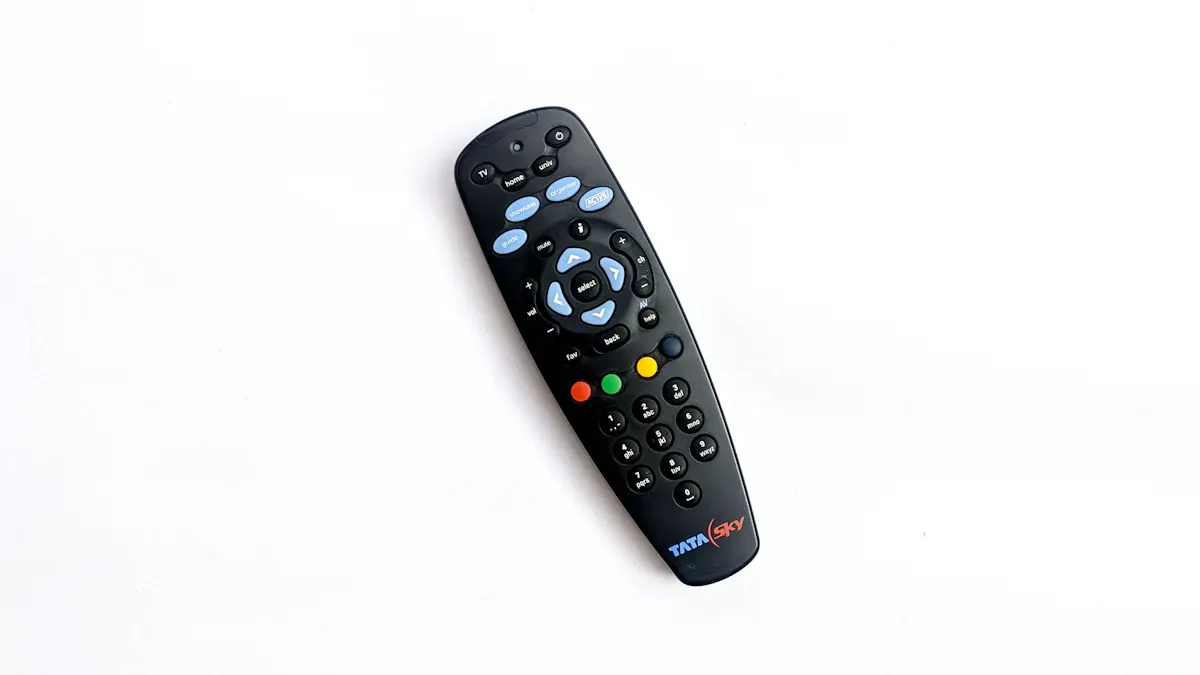
Emitter
The emitter is very important in infrared remote control systems. It makes modulated infrared light. This light sends signals to the device you want to control. Most emitters use an infrared light-emitting diode (IR LED) or a laser diode.
IR LEDs change electrical signals into low-frequency infrared light. They are popular because they are simple and cheap.
Laser diodes create focused light, which reduces energy loss. This makes them good for high-power uses. They are usually more efficient than IR LEDs. IR LEDs waste some energy as heat.
Many emitters have adjustable output settings. This lets you change the output to work with different devices. Low-power emitters are also available. They help prevent overdriving sensitive parts, which can cause problems.
Receiver
The receiver picks up the infrared signals from the emitter. It changes these signals into electrical signals for more processing. Common types of receivers are photodiodes, phototransistors, and avalanche photodiodes (APDs).
Feature | Photodiode | Phototransistor | Avalanche Photodiode |
|---|---|---|---|
Sensitivity | Good, but low output current (nA to μA) | Higher effective sensitivity due to gain | Extreme sensitivity but requires high reverse bias |
Photodiodes are fast and linear, but they have low output current. Phototransistors have higher sensitivity because of their gain, but they are slower and less linear. Avalanche photodiodes have very high sensitivity and bandwidth. They use avalanche multiplication of carriers under high reverse bias. They are great for high-sensitivity uses, like fiber-optic communications.
Power Supply
The power supply is another key part of infrared remote control systems. It gives the needed voltage and current to power the emitter and receiver. Usually, the standard operating voltage for these systems is 5 volts.
The power supply makes sure that active parts, like the IR receivers, can amplify and send signals well.
Sometimes, a 12 VDC power supply is used to improve performance.
Knowing the details of these core components helps you see how they affect the range and reliability of infrared remote control systems. For example, the operating frequency, sensitivity, and power use all matter in how well your remote control works.
Signal Transmission
Modulation and Encoding
In infrared remote control systems, modulation and encoding are very important. They help make sure the signal is sent reliably. Modulation is like getting the signal ready to be sent. The emitter uses a method called pulse width modulation (PWM) to encode data. This method helps tell the difference between two states: Marks (when the IR emitter sends a signal) and Spaces (when it does not).
Here are some key points about modulation and encoding:
Pulse width modulation helps the system send information well.
Modulating the LED with a carrier frequency improves the signal-to-noise ratio. This is important for clear communication.
The lead-in sequence helps the receiver adjust the gain of the photodiode. This improves the signal quality.
Transmission Process
The transmission process has several steps. These steps make sure the infrared signal goes from the emitter to the receiver well. Here’s how it works:
Instruction Input: You begin by pressing a button on the remote control. This sends a digital instruction signal from the microcontroller.
Carrier Modulation: The microcontroller creates a 38kHz carrier wave. This frequency is common in IR remote controls because it stands out from background IR noise.
Photoelectric Conversion: The modulated signal powers the infrared emission tube. This changes it into an infrared light signal.
Signal Reception: The IR receiver catches the emitted signal. It amplifies and changes the signal back into an electrical signal for more processing.
The table below shows the modulation frequencies often used in infrared remote control systems:
Modulation Frequency | Description |
|---|---|
Most common frequency in IR remote controls. It stands out from background IR noise. | |
30kHz, 33kHz, 36kHz, 40kHz, 56kHz | Supported by Vishay TSOP382 series receivers, but not as common as 38kHz. |
Other Frequencies | Can be used to avoid interference, but 38kHz is still the standard. |
Knowing these processes helps you see how the core components work together to send signals well.
Factors Affecting Signal Integrity
Many factors can affect the quality of the infrared signal during transmission. Here are some important things to think about:
Frequency: Lower frequencies can travel further than higher frequencies. This may cause signal loss or interference.
Antenna and Cable Selection: Choosing the right antenna and cable affects how well the signal is sent.
Antenna Height: The height of the antenna matters for line-of-sight and clearance. These are important for reducing interference.
By understanding these factors, you can learn how to improve the performance of infrared remote control systems.
Applications & Benefits
Common Applications
Infrared remote control systems are used in many areas of consumer electronics. Here are some common uses:
Application Area | Examples |
|---|---|
Home Entertainment | Televisions, stereos, DVDs, streaming devices |
Home Automation | Lighting, heating, security systems |
Toys and Gadgets | RC cars, drones, interactive toys |
Industrial Control | Machines and tools in factories |
Healthcare | Medical devices for precise control |
Automotive | Keyless entry systems, in-car infotainment |
Photography | Remote control of cameras |
These uses show how flexible infrared technology is in daily life.
Advantages of IR Systems
Infrared remote control systems have many benefits that make them popular. Here are some main advantages:
Low Cost: IR controllers are cheap to make and replace. This makes them easy to find for many devices.
Energy Efficient: They use very little energy, which is great for home appliances.
Simple to Use: Using an IR remote is easy. You just point and click.
No Interference: Infrared signals do not mess with other devices like Wi-Fi or Bluetooth. This ensures clear communication.
These benefits help create a better user experience. This makes infrared remotes a favorite choice for many people. You can enjoy the ease and efficiency they bring to your daily life.
In conclusion, the main parts of infrared remote control systems—emitters, receivers, and power supplies—are very important for good communication. Knowing about these parts helps you fix problems and take care of your devices better. Understanding how these simple pieces work together makes you appreciate the technology you use every day.
Infrared remote control systems use active and passive IR sensors.
They are light, small, and cheap, which makes them great for many uses.
By learning these ideas, you can understand the complexity behind the ease of wireless communication.
FAQ
What is the range of infrared remote controls?
Most infrared remote controls work well from 30 to 50 feet. This depends on how strong the emitter is and how sensitive the receiver is.
Can infrared signals pass through walls?
No, infrared signals cannot go through walls. They need a clear line of sight between the emitter and receiver to work well.
How do I troubleshoot my infrared remote control?
First, check the batteries. Then, make sure there is a clear line of sight. Clean the emitter and receiver too. If problems continue, think about replacing the remote.
See Also
Understanding The Functionality Of PLC Components In Automation
Leading Suppliers Of RF Components For 5G Technology
A Comprehensive Guide To Communication Chips And Their Functions
Exploring IC Audio Signal Processors And Their Main Features