The classification and detection principles of Hall effect sensors
Hall effect sensors are very important in today's technology. You can see them in many places, like cars and electronics. In 2023, the Hall effect sensors market was worth USD 2.3 billion. It is expected to grow a lot. For example, the car industry alone might go over USD 1.3 billion by 2032. Knowing how they are classified and how they detect things helps you understand how these sensors work and where they are used.
Operation of Hall Effect Sensors
Basic Principles
The Hall effect is an interesting event in conductive materials. When you send electric current through a conductor and put it in a magnetic field, the magnetic field interacts with moving charge carriers, like electrons. This interaction makes the charge carriers change direction, creating a measurable voltage across the conductor. This voltage is called Hall voltage.
Here are some important facts about the Hall effect:
Edwin Hall discovered the Hall effect in the 1870s.
It is named after him because of his important work.
This principle is key in sensor technology for measuring magnetic fields.
When the magnetic field gets stronger, the Hall voltage also gets stronger until it reaches a limit. This connection is important for how Hall effect sensors work.
Magnetic Field Strength (H) | |
|---|---|
Increases | Increases |
Saturation Point | Maximum Field Strength |
Components
A Hall effect sensor has several main parts that work together to find magnetic fields. Knowing these parts helps you see how the sensor works.
Component | Function |
|---|---|
Hall Element | Responds to magnetic fields and makes a small voltage. |
Amplifier | Boosts the voltage made by the Hall element. |
Voltage Regulator | Keeps a steady power supply to the sensor. |
Output Terminals | Sends the final electrical signal to the circuit. |
The Hall element is the main part of the sensor. It creates a voltage when it is near a magnetic field. The amplifier increases this voltage for clearer signals. The voltage regulator keeps a steady power supply, while the output terminals send the processed signal to the circuit.
Without a magnetic field, electrons in the semiconductor move evenly, so there is no voltage difference. But when a magnetic field is present, it changes the path of these electrons, causing an uneven charge distribution. This creates a measurable voltage difference across the output terminals, which is important for the sensor to work.
Common materials used in Hall effect sensors include:
Material | Description |
|---|---|
Gallium arsenide (GaAs) | A semiconductor known for its good response to magnetic fields. |
Indium arsenide (InAs) | Another semiconductor that works well in Hall effect uses. |
Indium phosphide (InP) | Used for its fast electron movement in sensor uses. |
Indium antimonide (InSb) | Known for being sensitive to magnetic fields. |
Graphene | A new material with great electrical features for sensors. |
These materials respond well to magnetic fields and help keep accuracy and stability in different conditions.
Types of Hall Effect Sensors
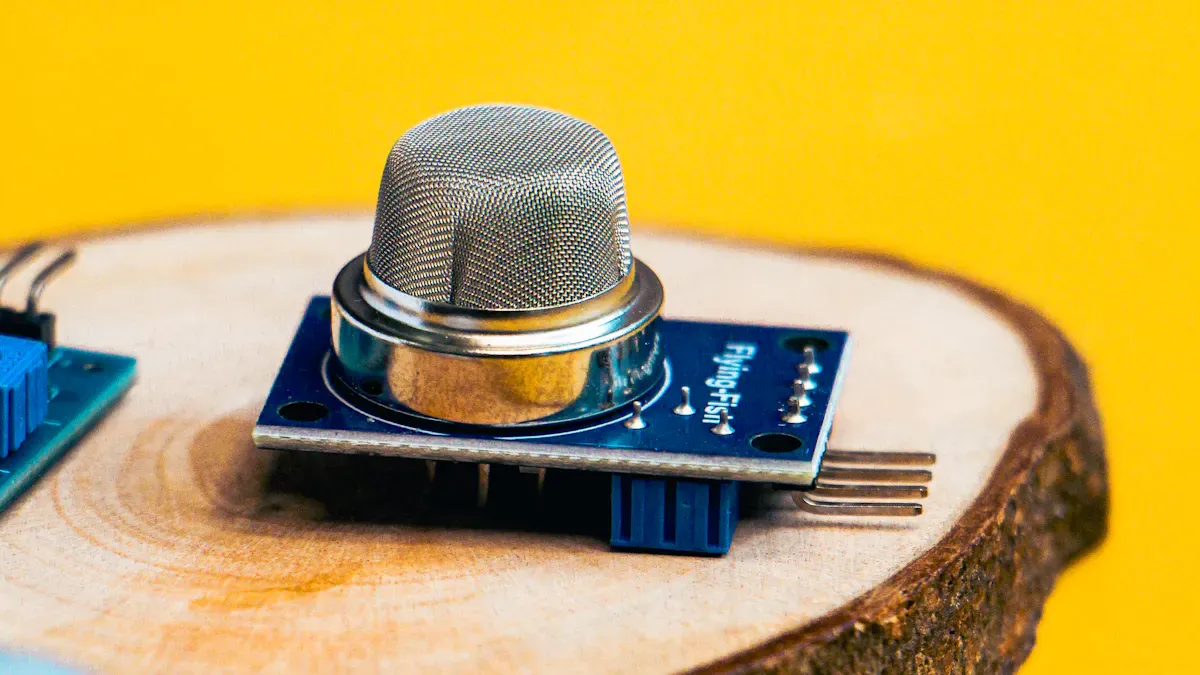
Hall effect sensors come in different types. Each type is made for specific uses. Knowing these types helps you pick the right sensor. Here are the main kinds:
Linear Hall Sensors
Linear Hall sensors give an analog output. This output changes with the strength of the magnetic field. These sensors have a Hall element, a linear amplifier, and an emitter follower. When a magnetic field is applied, the output voltage changes proportionally.
Feature | Linear Hall Sensors |
|---|---|
Output Characteristics | |
Sensitivity | Measured in mV/G or V/T |
Hysteresis | Minimal hysteresis |
Temperature Compensation | Often includes compensation circuits |
Power Consumption | Typically requires continuous power |
Durability | Superior longevity due to lack of mechanical components |
Response Time | Generally faster (microseconds range) |
Signal-to-Noise Ratio (SNR) | Higher quality sensors demonstrate superior SNR |
You can find linear Hall sensors in many uses. They measure magnetic fields, detect pedal positions in cars, and measure steering torque. They also help with non-contact position detection, like sensing volume knob rotation.
Digital Hall Sensors
Digital Hall sensors work like switches. They turn ON or OFF when a magnetic field reaches a certain level. This is important for counting, detecting openings, or making trigger signals.
One big benefit of digital Hall sensors is their reliable digital voltage output. This output is great for magnetic switch uses. It gives clear ON or OFF signals to the system.
You will see digital Hall sensors in many electronic devices. For example, they sense crankshaft positions in cars and help washing machines stay balanced during cycles.
Industry | |
|---|---|
Automotive | - Sensing seat and safety belt position for air-bag control |
- Sensing the angular position of the crankshaft for spark plug firing angle | |
Appliances and Consumer Goods | - Maintaining balance in washing machines during wash cycles |
Fluid Monitoring | - Monitoring flow rate and valve position in various processes |
Building Automation | - Automatic toilet flushing mechanisms |
- Automatic sinks, hand dryers, and security systems | |
Personal Electronics | - Motor control devices and timing mechanisms in photography equipment |
Switch Type Hall ICs
Switch type Hall ICs output digital signals. They have a voltage regulator, Hall element, differential amplifier, Schmitt trigger, and output stage. These sensors detect magnetic fields and change them into electrical signals.
When electric current flows through the sensor, a magnetic field makes the electrons shift. This creates a small voltage. This voltage is what the sensor reads, which is key for switch type Hall ICs.
Switch type Hall ICs can be split into subcategories, such as:
Automotive Magnetic Sensor ICs: These sensors are for cars. They detect magnetic poles and check the status of windows, doors, vehicle height, speed, and motor rotations.
Detection Methods: They have different detection methods, like bipolar detection (1-axis/2-axis), unipolar detection, and omnipolar detection.
Operational Features: These ICs can work at high temperatures (up to 150°C), are fast, withstand voltage, and are very thin (maximum thickness of 0.5mm).
Latch Type Hall ICs
Latch type Hall ICs act as digital output switches. They keep their output state until a magnetic field of the opposite polarity is applied. This means they need both positive (south polarity) and negative (north polarity) magnetic fields to work.
Feature | Description |
|---|---|
Functionality | Latch type Hall ICs are digital output switches that maintain their output state until a magnetic field of opposite polarity is applied. |
Magnetic Switchpoints | They require both positive (south polarity) and negative (north polarity) magnetic fields to operate. |
Applications | Commonly used for detecting the position of rotating shafts, utilizing multiple magnets in a ring magnet structure. |
Latch type Hall ICs are great for detecting the position of rotating shafts or other moving parts.
By learning about these types of Hall effect sensors, you can better understand how they work and choose the right sensor for your needs.
Applications of Hall Effect Sensors
Proximity Sensing
Hall effect sensors are very important for proximity sensing. They can find objects without touching them. This makes them great for many industrial tasks. For example, they are used in robots to see if nearby objects are present. They also check where parts are on assembly lines to keep things running well.
Here are some common uses of Hall effect sensors in proximity sensing:
Finding magnets.
Sensing ferrous metals with the right setup.
Improving productivity by reducing mechanical failures.
These sensors respond quickly, often in less than 1 microsecond, making them good for fast applications.
Speed Detection
In speed detection, Hall effect sensors are great at measuring how fast shafts rotate. They notice changes in magnetic fields from rotating parts. When a magnet on a shaft moves, the sensor picks up these changes for accurate speed readings. You can often find Hall effect sensors in tachometers, which measure how fast electric motors go.
Key applications include:
Checking wheel speeds in anti-lock braking systems (ABS).
Sensing crankshaft positions to adjust spark plug firing angles.
Controlling voltage in electrical systems.
These sensors usually respond in 1 to 10 microseconds, ensuring accurate and timely measurements.
Current Sensing
Hall effect sensors are also used a lot for current sensing. They measure the magnetic field from electric currents in conductors. This lets you check current levels in many uses, like power supplies and electric motors.
Some specific applications include:
Replacing mechanical breaker points in ignition systems.
Monitoring crankshaft and camshaft positions for correct engine timing.
Detecting angles using magnets on rotating shafts.
Using Hall effect sensors for current sensing helps you monitor electrical systems reliably and efficiently.
Advantages and Limitations
Benefits
Hall effect sensors have many good points that make them popular in different uses. Here are some main benefits:
Reliability and Durability: Hall effect sensors are built with solid parts. This makes them reliable and long-lasting. They do not wear out easily, which helps them last longer. Their smart designs include features to handle temperature changes and improve magnetic performance. Special packaging and techniques help them work well in tough conditions.
Energy Efficiency: These sensors help save energy by measuring current accurately without losing power. This means less energy is wasted as heat, which happens in other methods. In smart grids and renewable energy, Hall effect sensors help distribute and use energy better. They measure current in real-time, which helps balance loads and use renewable energy more effectively.
Challenges
Even though Hall effect sensors have many advantages, they also have some challenges. Here are some limitations to think about:
Challenge | Description |
|---|---|
Changes in temperature can affect how sensitive the sensor is and cause wrong output signals. | |
Humidity and moisture exposure | Moisture can cause rust and change Hall voltage because it gets inside the sensor. |
Electromagnetic interference (EMI) | Nearby electronic devices can create noise that hides real measurements in the output signals. |
Mechanical stress and vibration | Stress can change the Hall coefficient, leading to errors in measurements. |
Atmospheric pressure variations | Changes in pressure can stress the sensor, affecting its calibration. |
Exposure to radiation | Radiation can harm the semiconductor, making it less sensitive after exposure. |
Dust and particulate contamination | Dust can build up and affect how the sensor works and how it cools down. |
Also, Hall effect sensors can have issues with sensitivity and accuracy. For example, drift can be as much as ±0.1% for every degree Celsius, needing complex adjustments. Changes in the Hall coefficient can be up to ±5%, which means each sensor may need its own calibration for accuracy.
By knowing these advantages and challenges, you can choose the right Hall effect sensors for your projects.
Comparison with Other Sensors
Magnetic Sensors
When you look at Hall effect sensors and other magnetic sensors, you see some important differences. Hall effect sensors are usually cheaper and easier to use. They work well in everyday electronics and simple car systems, where high accuracy is not very important.
Here’s a quick comparison of different sensor types:
Sensor Type | Cost | Performance | Applications |
|---|---|---|---|
Hall Effect Sensors | Medium accuracy | Consumer electronics, basic automotive | |
TMR/Fluxgate Sensors | High | High accuracy | Demanding environments, precise tasks |
In electric cars, Hall sensors had a position error of 3.2mm at high temperatures. On the other hand, TMR sensors reduced this error to just 0.15mm, showing better performance in important situations.
Proximity Sensors
Proximity sensors are also important for finding objects without touching them. However, they work differently than Hall effect sensors. Here’s how they compare:
Feature | Hall Effect Sensors | Proximity Sensors |
|---|---|---|
Detection Method | Detects magnetic fields and turns them into signals | Detects presence using electromagnetic fields |
Accuracy | Varies based on the technology used | |
Durability | Very durable, good for changing environments | Durability varies by type |
Output Type | Can give digital or analog output | Usually gives discrete output |
Application | Used for linear or angular position sensing | Commonly used for object detection |
Hall effect sensors are very reliable and often replace reed and mechanical switches. They are good for both linear and angular position sensing, offering different output options for various uses.
By knowing these differences, you can pick the right sensor for your needs. Whether you want low cost, high precision, or durability, understanding each sensor type's strengths helps you make smart choices.
Hall effect sensors are very important in today's technology. They are used in many areas, like cars and electronics. Knowing how they work and the different types helps you see why they matter.
As technology improves, there will be new trends in Hall effect sensors. Here are some cool changes to look for:
Trend/Innovation | Description |
|---|---|
Miniaturization | Smaller sensors that fit better in electronic devices. |
Wireless Technology | More wireless sensors for easy monitoring and installation. |
Enhanced Accuracy and Sensitivity | Better materials and designs for accurate measurements, great for automation and electric cars. |
Integration with Smart Systems | Use in smart grid tech for real-time monitoring and data analysis. |
Sustainability Focus | Growing need for energy-saving solutions that support renewable energy and electric vehicles. |
Dive deeper into Hall effect sensors. Their possibilities keep expanding, influencing the future of technology.
See Also
A Beginner's Guide to Designing Pressure Sensor Circuits
Exploring Temperature Sensor Chips and Their Main Characteristics
Understanding the Functions and Applications of Photodiode ICs
Basics of Analog IC Design and Its Practical Applications
Current Controller Chips: Their Functionality and Purpose Explained