Basic peripheral circuits of MCU microcontrollers
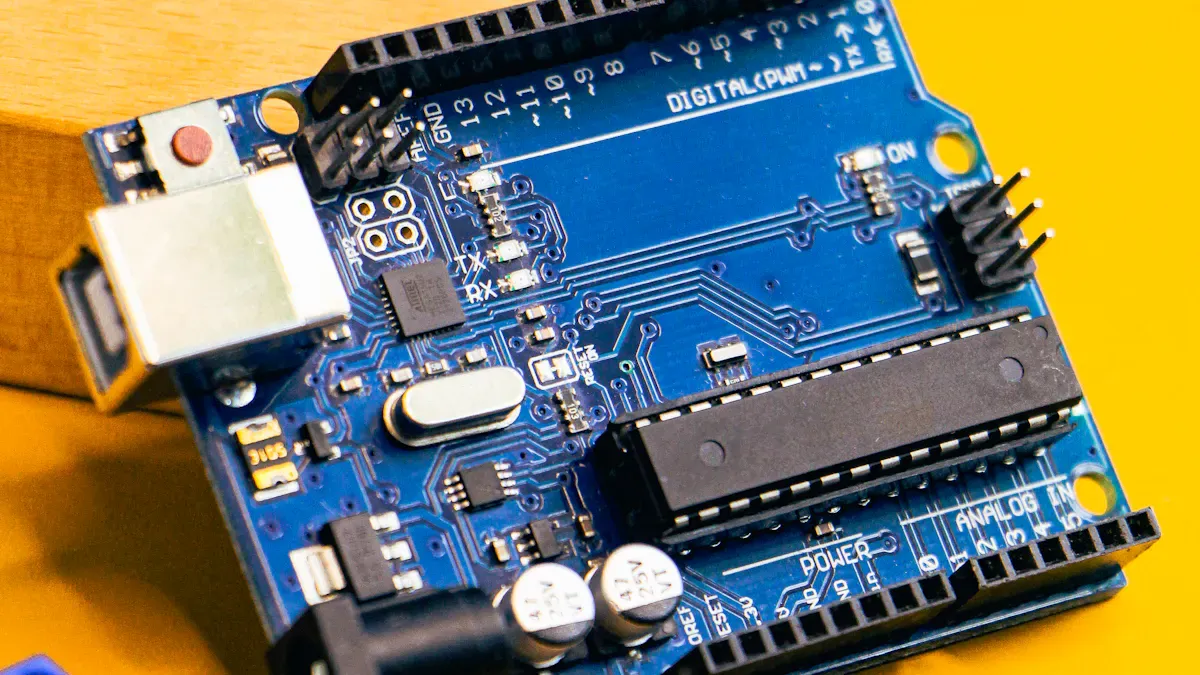
Basic peripheral circuits are very important in microcontroller uses. They help microcontrollers work well with the outside world. These circuits add useful features, like changing analog signals to digital ones and allowing communication. For example, having 14 ADC channels lets you do accurate analog-to-digital conversions. This is great for things like environmental sensing, where getting exact data matters. By learning about these circuits, you can make the most of your microcontroller projects.
Basic Peripheral Circuits: GPIO
GPIO Functionality
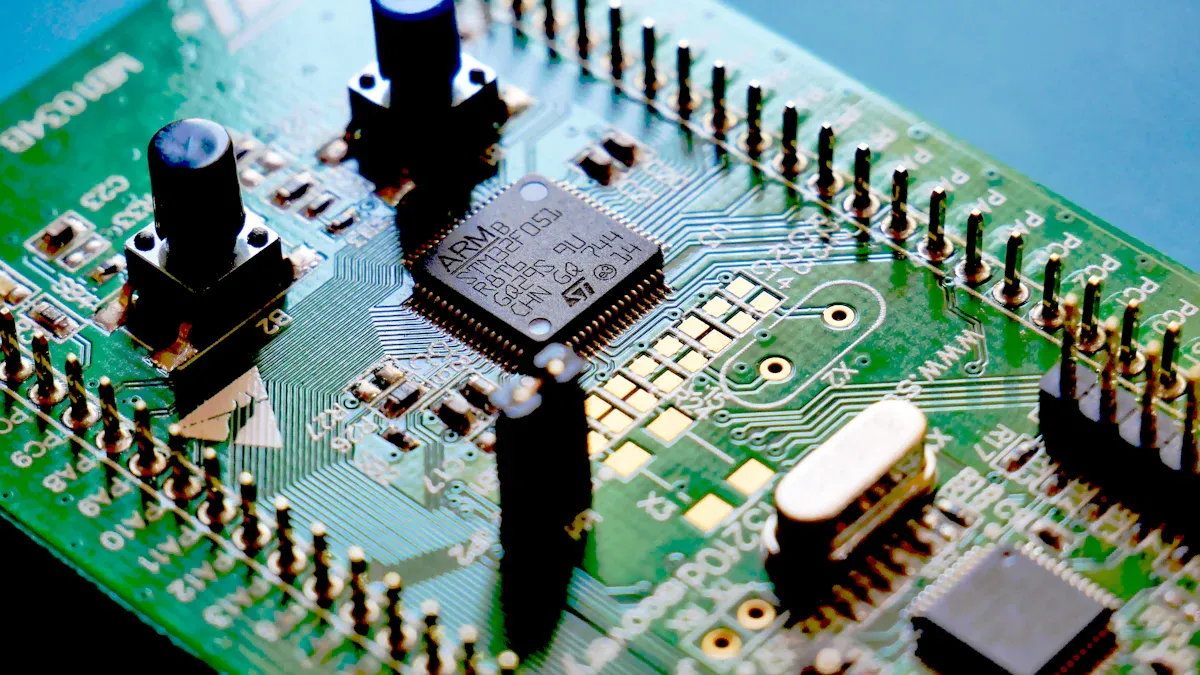
General Purpose Input/Output (GPIO) pins are very important in microcontrollers. They help you connect with the outside world by reading inputs and sending outputs. You can set up GPIO pins in many ways. This makes them useful for different tasks. Here are some main functions of GPIO pins:
Functionality Description | Example Use Case |
|---|---|
GPIO pins can be set up for different input and output tasks. | Reading sensor data or controlling LEDs |
They allow flexibility in projects, letting the same microcontroller work on different tasks. | Adapting to different peripherals |
Pins can also do other jobs when not used for regular input/output. | PWM signal generation |
GPIO pins can work in three states: Logical 0 (ground), Logical 1 (VCC), and High-impedance (floating). The high-impedance state lets many devices share output lines. This stops input/output conflicts. You can use pull-up resistors to set a default state for floating signals. This helps get reliable input readings. When set as input, GPIO pins read signal states in high-impedance, pull-up, or pull-down modes. For output, setups include push-pull (which can send or take current) and open-drain (which only takes current).
GPIO Use Cases
GPIO pins are very important in embedded systems. Here are some common uses:
Using GPIO for input to trigger hardware interrupts.
Setting up pins to check button presses.
Using hardware interrupts to let the processor rest from constant checking.
These uses show how GPIO pins improve basic peripheral circuits in microcontroller projects. However, you might face some problems when using GPIO circuits. For example, the number of GPIOs can change a lot between different microcontroller boards. This can affect your project design. Also, beginners might get confused with different names for GPIOs, which can lead to mistakes.
Challenge | Description |
|---|---|
Limitations on available GPIOs | The number of GPIOs can change a lot between different microcontroller boards, affecting project design. |
Confusion with pin labels | Beginners might get confused with different names for GPIOs, which can lead to mistakes. |
Need for additional components | Some GPIOs might need extra parts for proper function, making the circuit design harder. |
Knowing how GPIO works and its different uses will help you create better microcontroller projects. By learning these basic peripheral circuits, you can build more interactive and responsive systems.
Basic Peripheral Circuits: Timers
Timer Functions
Timers are very important in microcontrollers. They help you manage tasks that depend on time. Here are some main functions that timers provide:
Function | Description |
|---|---|
Time Delays & Scheduling | Timers create exact delays for tasks or schedule them to run regularly. |
PWM (Pulse Width Modulation) | Timers make square wave signals with different pulse widths to control power to devices. |
Used for | Applications include motor control, signal generation, and real-time clock functions. |
You can use timers to run tasks at certain times. This is key for real-time operations. Timers also help you measure time between events. For example, you can track how long a button is pressed or how long it takes for a sensor to read data.
Timer Applications
Timers have many uses in embedded systems. Here are some common ones:
Executing periodic tasks: Timers run tasks at regular times, keeping your system working well.
Implementing PWM outputs: Timers create Pulse Width Modulation signals to control motors and LEDs.
Capturing elapsed time: Timers measure the time between two events, helping you track durations accurately.
Timers are also important for saving power in low-power microcontroller designs. But using higher timer resolutions can increase average current use. For example, setting a timer to milliseconds can use much more current than seconds. This difference can be more than ten times. So, you should change the timer when switching between low power and normal modes. This change can cause a loss of real-time clock accuracy, with possible delays of up to 999 ms during transitions.
In industrial uses, timers help manage time-based tasks like:
Pulse Width Modulation (PWM): Used for controlling motors, dimming LEDs, and making analog signals from digital data.
Event Timing: Measuring how long an event lasts, like a button press or a sensor reading.
Task Scheduling: Making sure tasks happen at exact times in real-time systems.
By learning about timer functions and uses, you can improve your microcontroller projects. Timers are key parts of basic peripheral circuits, helping you create responsive and efficient systems.
Basic Peripheral Circuits: ADC
ADC Functionality
Analog-to-Digital Converters (ADCs) are very important in microcontrollers. They change continuous analog signals into digital values. This process has a few key steps:
Sampling: The ADC samples the input signal regularly. It takes snapshots of the analog signal over time.
Quantization: After sampling, the ADC quantizes the values it sampled. This step adds a small error called quantization error.
Conversion: The ADC then changes these quantized values into a digital format. This conversion happens often, which limits the input signal's bandwidth.
The resolution of an ADC shows the smallest change it can notice. Higher resolution means more precise measurements. This improves the accuracy of the digital version of the analog signal.
ADC Applications
ADCs have many uses in microcontroller projects. Here are some common examples:
Application Type | Description |
|---|---|
Data Acquisition Systems | ADCs change analog signals into digital data for CPUs to process. |
Sensor Networks | Microcontrollers use ADCs to collect data efficiently in battery-powered sensors. |
Environmental Monitoring | ADCs read sensor data, allowing real-time checks of environmental conditions. |
ADCs are key for connecting with sensors in embedded systems. They turn analog signals from sensors into digital data that microcontrollers can use. This ability helps embedded systems work well with real-world inputs. Key functions include changing voltage signals into binary numbers and setting resolution for accuracy. Applications include temperature sensing, audio signals, and light sensors.
Knowing how ADCs work and where they are used will help you design better microcontroller projects. By using these basic peripheral circuits, you can build systems that respond accurately to changes in the environment.
Basic Peripheral Circuits: Communication Protocols
Overview of Protocols
Communication protocols are very important for microcontrollers. They help devices share data easily. Here are some common communication protocols used in microcontroller projects:
UART (Universal Asynchronous Receiver-Transmitter)
SPI (Serial Peripheral Interface)
I2C (Inter-Integrated Circuit)
USB (Universal Serial Bus)
RS-232
RS-422
RS-485
CAN (Controller Area Network)
Each protocol has special features that make it good for certain tasks. Knowing these differences helps you pick the right one for your project.
Protocol Use Cases
Now, let's look at how UART, SPI, and I2C are different in speed, complexity, and uses. The table below shows these details:
Characteristic | I2C | SPI | UART |
|---|---|---|---|
Speed | Average (up to a few Mbit/s) | High (several Mbit/s to a few tens of Mbit/s) | Moderate (lower than that of SPI) |
Complexity | Moderate (2 wires, managing several slaves) | Moderate to high (4-wire, full-duplex) | Moderate (2 wires, full-duplex) |
Use | Best for short-distance communication with many devices | Great for fast data transfers | Good for simple and long-distance serial communication |
Duplex | Half-duplex (two-way communication but not at the same time) | Full-duplex (two-way communication at the same time) | Full-duplex (two-way communication at the same time) |
UART is often used to connect Bluetooth and GPS modules. You can also find it in DIY electronics like Raspberry Pi and Arduino projects.
SPI is great for fast data transfer. It uses a shared clock signal for clear and quick communication. This protocol allows full-duplex operation, meaning it can send and receive data at the same time. You can use SPI for tasks needing quick data collection, like working with ADCs.
I2C is perfect for sensor networks. It only needs two wires, making it easy to set up. This protocol allows communication with many devices, which is helpful for growth. You can use I2C to connect multiple sensors, real-time clocks, and EEPROMs.
By learning about these communication protocols, you can use basic peripheral circuits well in your microcontroller projects.
Knowing about basic peripheral circuits is very important for doing well in microcontroller projects. These circuits help you connect better with the outside world. They also make your designs work better. Here’s a simple look at how different parts help your projects:
Role in Microcontroller Design | |
|---|---|
Pull-Up Resistors | Keep MCU input pins steady, making sure they work well and don’t reset by mistake. |
LED Series Resistors | Control current to LEDs, stopping damage and making sure they shine correctly. |
Filter Capacitors | Reduce noise in the power supply and keep voltage steady, which is key for the MCU to work reliably. |
Transistors | Act as switches, amplifiers, and level shifters, improving control and signal quality in circuits. |
Port Expansion | Let you control more peripherals when I/O pins are not enough, boosting system capabilities. |
By learning these basic peripheral circuits, you can build better and more responsive systems. Dive deeper into these ideas in your projects to fully use your microcontroller's abilities.
See Also
Grasping The Fundamentals Of Microcontrollers And Flash Memory
Exploring The Functionality Of MCU Microcontroller Chips
The Importance Of MCUs With FPUs In Embedded Systems
Features Of The 32-bit ARM Cortex MCUs You Will Enjoy
Defining High-Performance Microcontroller Integrated Circuits