Exploring the Future of AI Chip Market Dynamics
AI chips play a vital role in modern technology, significantly influencing chipmarkettrends. They drive advancements in various sectors such as healthcare, automotive, and finance. The global AI chip market is projected to reach an impressive $846.8 billion by 2035, reflecting the ongoing chipmarkettrends. You can expect a compound annual growth rate of around 35% through 2033. Companies like NVIDIA and Intel lead innovations that enhance efficiency and enable real-time decision-making, shaping the future of chipmarkettrends. In healthcare, AI chips power diagnostic imaging and personalized medicine. In the automotive sector, they support advanced driver-assistance systems. With 64% of companies believing AI will boost productivity, the demand for AI chips continues to rise, further driving chipmarkettrends.
Key Takeaways
The AI chip market is set to grow significantly, reaching an estimated $1,104.68 billion by 2035, driven by increasing demand across various sectors.
Key segments like edge AI processing and ASICs are leading the market, highlighting the importance of real-time data processing in modern applications.
Technological innovations, such as advanced chip designs and neuromorphic processors, are enhancing performance and efficiency in AI applications.
Supply chain challenges, including geopolitical tensions and market concentration, pose risks to the growth of the AI chip market.
Major companies like NVIDIA and Intel dominate the market, employing strategies that focus on innovation and meeting the rising demand for AI capabilities.
AI Chip Market Overview
Market Size and Growth Projections
The AI chip market is experiencing rapid growth. As of 2025, the market was valued at approximately USD 94.44 billion. You can expect this figure to rise to USD 121.73 billion in 2026. By 2035, the market could reach around USD 1,104.68 billion. This growth represents a compound annual growth rate (CAGR) of 27.88% from 2026 to 2035.
Here are some key projections for the AI chip market:
2025: USD 94.44 billion
2026: USD 121.73 billion
2030: USD 293 billion
2035: USD 1,104.68 billion
Leading Market Segments
Several segments lead the AI chip market in terms of revenue and adoption. The following table highlights the revenue share of key segments in 2025:
Segment Type | Revenue Share (%) | Year |
|---|---|---|
ASIC | 25 | 2025 |
Edge AI Processing | 74 | 2025 |
Computer Vision | 26 | 2025 |
North America | 38.72 | 2025 |
Europe | 32.17 | 2025 |
The edge AI processing segment stands out with a significant revenue share of 74%. This segment plays a crucial role in enabling real-time data processing on devices, which is essential for applications like autonomous operations and smart home technologies.
As you can see, the AI chip market is not only growing rapidly but also diversifying. The chipmarkettrends indicate that these segments will continue to evolve, shaping the future of technology.
Drivers of Growth in ChipMarketTrends
Demand for AI Applications
The demand for AI applications drives significant growth in the AI chip market. You can see this demand across various industries, including healthcare, automotive, and finance. As AI becomes integral to these sectors, the need for specialized AI chips increases. Here are some key factors contributing to this trend:
Factor | Explanation |
|---|---|
AI integrates into sectors like healthcare and automotive, driving demand for specialized AI chips. | |
Advancements in Deep Learning and Neural Networks | Progress in algorithms requires high-performance computing, increasing the need for AI hardware. |
Expansion of Data Centers | More data centers are needed to process vast data, necessitating AI chips for enhanced computational power. |
Growth in Edge Computing | Processing data closer to the source reduces latency, increasing demand for AI chips in edge devices. |
Government and Corporate Investments | Significant funding in AI research supports market growth and technological advancements. |
Emergence of Autonomous Systems | Development of self-driving cars and drones relies on AI chips for real-time processing. |
Proliferation of Big Data | The growth of big data requires powerful AI chips for processing and analytics. |
Advancements in AI-Powered Healthcare Solutions | AI in healthcare for diagnostics and personalized medicine drives demand for AI chips. |
The integration of AI chips in autonomous vehicles exemplifies this demand. These chips enhance advanced driver-assistance systems, improving safety and efficiency. They enable real-time data processing and object detection, essential for navigation and smart transportation. As electric and autonomous vehicles gain popularity, the need for AI chips in the automotive industry continues to rise.
Technological Innovations
Technological innovations significantly impact the AI chip market dynamics. Recent advancements in chip design and manufacturing processes have improved performance and efficiency. Here are some notable innovations:
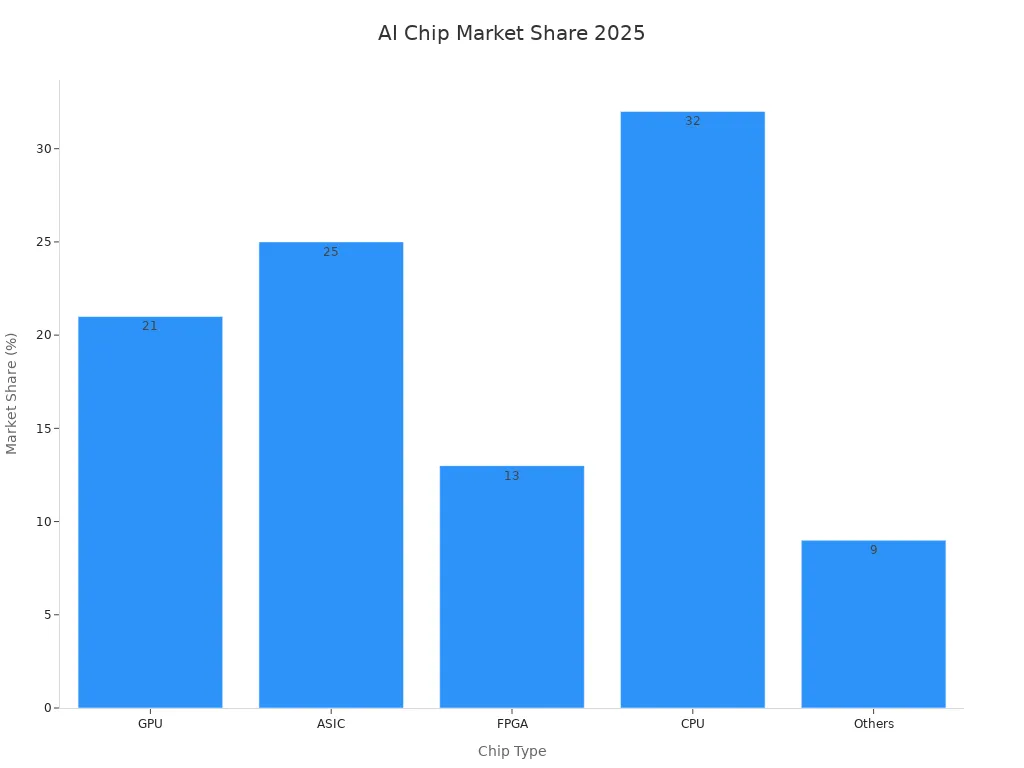
Chip Type | Market Share in 2025 | Key Innovations and Trends |
|---|---|---|
Graphics Processing Unit (GPU) | 21% | Specialized for parallel processing, energy-efficient models for edge computing, enhancing performance in AI workloads. |
Application-Specific Integrated Circuit (ASIC) | 25% | Custom-designed for specific tasks, optimized for deep learning, superior performance and energy efficiency. |
Field-Programmable Gate Array (FPGA) | 13% | Reconfigurable for specific tasks, flexibility in low-latency processing, advancements in programming ease. |
Central Processing Unit (CPU) | 32% | General-purpose, continuous improvements in architecture for AI performance, integration with AI accelerators. |
Neuromorphic Processing Unit (NPU) | N/A | Mimics human brain structure, efficient for sensory data processing, increasing adoption in edge devices. |
Others | 9% | Includes emerging technologies like TPUs and quantum processors, focusing on efficiency and scalability. |
The semiconductor industry is also evolving due to the rapid adoption of AI. This transformation affects the entire value chain, from chip design to manufacturing. The exponential growth of big data across industries necessitates powerful AI chips capable of processing and analyzing massive datasets. Producing AI chips at or below 5 nm requires precision manufacturing and high-cost EUV lithography systems. This raises capital intensity and affects innovation cycles.
Challenges in the AI Chip Market
Supply Chain Constraints
The AI chip market faces several supply chain challenges that can hinder growth. Geopolitical tensions and trade wars complicate the supply chain. You may notice that the concentration of production among a few companies creates vulnerabilities. This situation can lead to significant disruptions. Here are some key issues affecting the supply chain:
Tariffs and Export Restrictions: Tariffs increase production costs. For example, Taiwan faces a 20% general tariff, although semiconductors are currently exempt. However, semiconductor manufacturing equipment faces a 32% tariff, which raises costs for companies like TSMC. This situation complicates the cost structure for producing second-tier chips in the U.S.
Market Concentration: Antitrust enforcement is increasing across the AI chip supply chain. Authorities are investigating market concentration at critical production stages. They are examining potential anticompetitive practices that could limit competition.
Technological Limits: The industry is nearing physical limits in semiconductor technology. This limitation hinders future advancements and complicates the development of new AI chips.
The COVID-19 pandemic has also reshaped global supply chains. The ASEAN region has emerged as a preferred destination for manufacturing investment, surpassing China in attractiveness for foreign direct investment in the semiconductor sector. This shift may provide new opportunities but also introduces new challenges.
Competitive Landscape
The competitive landscape in the AI chip market is intense. Several key players dominate the market, and their strategies significantly impact chipmarkettrends. Here are some of the top competitors and their market shares:
NVIDIA: Leads in data center acceleration.
AMD: Fastest-growing in high-performance AI chips.
Intel: A major player in the AI chip market.
Qualcomm: Holds a significant presence in mobile AI solutions.
Google: Develops a vertically integrated AI computing stack.
These five companies account for nearly 64% of the AI chip market share in 2024. To maintain a competitive edge, these companies employ various strategies:
Company | Strategy Description | Financial Performance |
|---|---|---|
NVIDIA | Dominant in data center acceleration | FY2025 revenue: USD 130.5 billion, Q3 FY2026 revenue: USD 57.0 billion (89% from data center) |
AMD | Aggressive challenger with a focus on hyperscale AI workloads | Expects data center chip market to grow to USD 1 trillion |
Alphabet | Building a vertically integrated AI computing stack | Developed TPUs for internal use, competing with NVIDIA |
Dell | Strong monetizer of AI hardware through server systems | Anticipates USD 15 billion in AI server revenue in fiscal 2026 |
Regulatory challenges also play a role in shaping the competitive landscape. The Trump administration is expected to maintain strict export controls on AI technology. This situation impacts international trade and complicates compliance for companies in the market. Additionally, accusations of antitrust issues, such as those against Nvidia, indicate that regulatory scrutiny is a significant challenge.
Technological Advancements in AI Chips

Innovations in Chip Design
Recent innovations in chip design have transformed the AI chip landscape. You will notice a significant shift towards advanced architectures, particularly with the introduction of 3 nm and 5 nm nodes. These innovations provide up to 45% higher performance efficiency compared to older 7 nm chips. By 2024, over 68% of AI chip production will utilize nodes smaller than 7 nm. This trend highlights the industry's focus on miniaturization and power optimization.
Hybrid chip designs are becoming standard. These designs combine CPUs, GPUs, and NPUs, resulting in processing speeds that are 3.5 times faster for AI models. They also reduce latency by nearly 40%. Neuromorphic and quantum AI processors are emerging as well. Neuromorphic chips mimic human brain functions, achieving 80% lower power consumption in applications like autonomous systems and edge devices.
Description | |
|---|---|
Domain-Specific Accelerators | AI chips designed for specific workloads enhance compute efficiency, reduce latency, and help manage complex AI models in data centers. |
Energy-Efficient Architectures | New ultra-energy-efficient designs reduce energy consumption while improving thermal stability and performance, supporting sustainability goals in data centers. |
Chiplet and 3D Packaging Designs | Chiplet-based and advanced 3D packaging designs increase bandwidth, compute density, and scalability, enabling faster AI processing and modular high-performance architectures. |
Liquid-Cooling-Compatible Chips | Chips optimized for liquid cooling minimize overheating risks and ensure reliable performance during demanding AI training tasks, addressing the heat produced by AI workloads. |
Future Technologies
Looking ahead, several emerging technologies will shape the future of AI chips. Advanced chip architectures like 3 nm and 5 nm nodes will continue to enhance performance efficiency. Neuromorphic processors will lead to substantial power savings by mimicking human brain functions. Additionally, integrating AI capabilities into embedded systems will drive real-time decision-making across various applications.
You can also expect quantum computing to influence AI chip development. Quantum computing can enhance AI algorithms by efficiently handling large datasets. It performs complex computations that traditional computers struggle with, leading to more powerful AI chips. This technology is expected to drive advancements in fields like material science and complex system optimization.
As you explore these advancements, keep an eye on how they will impact chipmarkettrends. The future of AI chips looks promising, with innovations paving the way for smarter and more efficient technologies.
Regional Insights and Market Dynamics
North America
North America dominates the global AI chip market, holding approximately 38% of the market share as of 2024. This leadership stems from a strong ecosystem of cloud providers and semiconductor manufacturers. Several factors contribute to North America's success in AI chip innovation and adoption:
Factor | Description |
|---|---|
Growing Demand for AI-Enabled Applications | The rise of AI in sectors like healthcare and autonomous vehicles increases the need for advanced chips. |
Advancements in Semiconductor Technologies | Innovations in chip fabrication processes enhance performance and energy efficiency for AI workloads. |
Strategic Investments and Partnerships | Significant funding from tech firms and investors supports a dynamic ecosystem for AI hardware startups. |
Programs like the U.S. CHIPS Act strengthen domestic chip manufacturing and research efforts. | |
Edge Computing Expansion | The growth of IoT requires specialized chips for local data processing, reducing cloud dependency. |
These factors create a fertile ground for AI chip development, ensuring that North America remains at the forefront of this technology.
Asia-Pacific and Europe
The Asia-Pacific region is experiencing rapid growth in the AI chip market. This growth results from the expansion of technology-driven industries and the increasing adoption of AI-driven devices across various sectors. Key contributors include:
Healthcare device manufacturers like Neusoft Medical Systems and Narang Medical Limited are expanding their manufacturing capabilities.
Autonomous vehicle manufacturers such as Tata Motors, Toyota, and Daimler are ramping up production, creating opportunities for AI chip revenue growth.
In Europe, the edge AI chips market is lucrative due to the rising adoption of AI technologies across industries. Factors driving this growth include:
A focus on data privacy and security, which boosts demand for edge AI solutions.
Leading technology companies and research institutions in Germany, France, and the UK are fostering innovation in this field.
Government policies also play a crucial role in supporting AI chip industry expansion. For example:
China aims to establish itself as a global AI rulemaker.
Japan strives to be an 'AI-friendly' leader with flexible regulations.
South Korea focuses on strengthening its domestic AI industry while addressing data privacy concerns.
These regional dynamics highlight the diverse landscape of the AI chip market, showcasing both established leaders and emerging players.
The AI chip market is on a remarkable growth trajectory. Here are some key findings:
Key Finding | Description |
|---|---|
Market Growth | The AI chip market is experiencing high double-digit growth rates, driven by demand from data centers and edge devices. |
Government Investment | Significant government funding is directed towards semiconductor incentives, highlighting the strategic importance of AI chip production. |
Future Projections | By 2030, the AI chip market is expected to reach hundreds of billions, potentially surpassing traditional semiconductor categories. |
Looking ahead, you can expect trends such as increased competition among major players and the rise of custom AI silicon in various applications. These advancements will benefit manufacturers, investors, and end-users alike, enhancing efficiency and productivity across industries. As the semiconductor landscape evolves, staying informed will be crucial for all stakeholders.
FAQ
What are AI chips used for?
AI chips power various applications, including machine learning, data analysis, and real-time decision-making. You will find them in sectors like healthcare, automotive, and finance, enhancing efficiency and performance.
How do AI chips differ from traditional chips?
AI chips specialize in processing large datasets and complex algorithms. They optimize performance for AI tasks, unlike traditional chips designed for general computing. This specialization allows AI chips to handle specific workloads more efficiently.
What factors drive the growth of the AI chip market?
The growth of the AI chip market stems from increasing demand for AI applications, advancements in technology, and the expansion of data centers. You can also attribute growth to government investments in AI research and development.
Who are the leading companies in the AI chip market?
Key players in the AI chip market include NVIDIA, Intel, AMD, Qualcomm, and Google. These companies dominate the market by developing innovative technologies and solutions tailored for AI applications.
What challenges does the AI chip market face?
The AI chip market faces challenges such as supply chain constraints, geopolitical tensions, and intense competition. These factors can hinder growth and impact the availability of AI chips in the market.
See Also
New Developments in Automotive Chip Technology for Future Needs
Current Trends Influencing the Analog Integrated Circuit Sector
Key Innovations Transforming Local Memory Chip Production Processes
Leading Advances in Medical Imaging Processing Chip Technologies